
Events
IFML Seminar
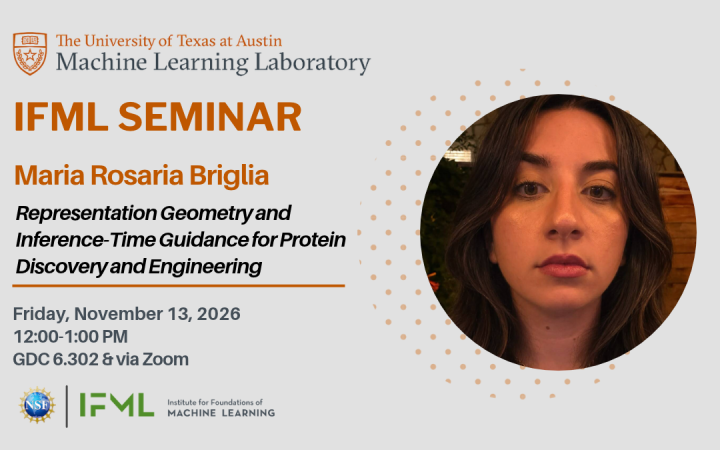
IFML Seminar: 11/13/26 - Representation Geometry and Inference-Time Guidance for Protein Discovery and Engineering
Maria Rosaria Briglia, Sapienza University of Rome, visiting researcher
-The University of Texas at Austin
2317 Speedway
Gates-Dell Complex (GDC) 6.302
Austin, TX 78712
United States
Abstract: Translating machine learning into practical protein design requires two core capabilities: mapping natural enzyme-reaction space to discover novel biocatalysts and navigating multi-mutant sequence landscapes under strict experimental budgets. This talk presents two complementary computational frameworks that address these bottlenecks across natural discovery and targeted protein engineering.
First, we present CIRCE (Chemistry-Informed Reaction-Catalyst Embeddings), a contrastive dual-encoder framework for bidirectional enzyme-reaction retrieval. Operating sequence-only at inference, CIRCE combines ProtT5 enzyme embeddings guided by functional-residue priors (SLEEC) with multimodal reaction descriptors encoding molecular 3D geometry, chirality, cofactors, and participant stoichiometry. Trained with an anchor-balanced multi-positive objective and full-graph residual refinement, CIRCE builds a shared embedding space that reflects catalytic promiscuity, achieving state-of-the-art results on EnzymeMap screening and ReactZyme retrieval benchmarks.
Second, we introduce APEX (Anchored Protein Engineering via quantized expectation), an inference-time method for fixed-budget multi-mutant design that keeps base generative models and reward predictors frozen. APEX decouples edit-site selection from residue decoding: Phase I screens candidate positions using pairwise reward interactions, while Phase II steers base-model probability distributions toward high-reward substitutions using straight-through quantized-expectation guidance. Across masked language, discrete diffusion, and inverse-folding models, APEX significantly optimizes targets like thermostability, solubility, and binding fitness while preserving evolutionary and structural plausibility.
Together, CIRCE and APEX illustrate how combining chemistry-informed representation geometry with controllable inference-time guidance creates a scalable, end-to-end blueprint for biocatalyst discovery and targeted variant design.
Bio: Maria Rosaria Briglia is a visiting researcher at the Institute for Foundations of Machine Learning (IFML) at UT Austin, working alongside Prof. Adam Klivans on generative models for proteins, representation learning, and mechanistic interpretability for protein engineering. Their primary research investigates the safety and robustness of generative models, focusing on representation space geometry, energy-based formulations, and multimodal system security to design principled defenses. Prior to starting doctoral work at Sapienza University of Rome, Maria Rosaria completed an M.Sc. in Computer Engineering at the University of Salerno, specializing in artificial intelligence and intelligent robotics.
Zoom link: https://utexas.zoom.us/j/89110047398