
IFML Researcher Jerry Li Awarded 2026 Gödel Prize for Landmark Machine Learning Breakthrough
IFML researcher Jerry Li has been awarded the 2026 Gödel Prize, one of the highest honors in theoretical computer science, for foundational work that changed how modern machine learning systems handle imperfect, noisy, and corrupted data.
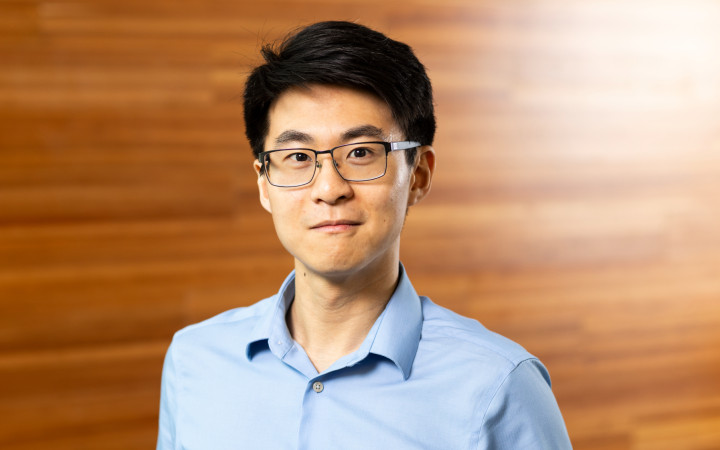
IFML researcher Jerry Li has been awarded the 2026 Gödel Prize, one of the highest honors in theoretical computer science, for foundational work that changed how modern machine learning systems handle imperfect, noisy, and corrupted data. This is a problem that affects everything from scientific discovery to the reliability of AI systems used in real-world applications.
The award recognizes the paper Robust Estimators in High Dimensions Without the Computational Intractability, which established an entirely new direction in algorithmic high-dimensional robust statistics. First presented at the IEEE Symposium on Foundations of Computer Science (FOCS) in 2016 and later published in the SIAM Journal on Computing, the paper was coauthored by Ilias Diakonikolas, Gautam Kamath, Daniel Kane, Jerry Li, Ankur Moitra and Alistair Stewart. Awarded annually by ACM SIGACT and the European Association for Theoretical Computer Science, the Gödel Prize recognizes papers that have made deep, lasting contributions to theoretical computer science.
While the award-winning research predates IFML, Li has been involved with the institute since its inception as one of the original senior personnel on its founding proposal. Since then, he has collaborated extensively with IFML researchers, mentored students across partner institutions and helped strengthen the institute's collaborative research community.
"IFML has been a really valuable community throughout my career," Li said. "I've collaborated with many researchers across the institute, and it's been a tremendous resource for workshops, student collaborations and new ideas."
Making Machine Learning More Reliable
Modern machine learning depends on enormous datasets, but real-world data is rarely perfect. Measurements can be inaccurate, records may be entered incorrectly, or information collected from multiple sources can contain corrupted or unreliable entries.
For decades, researchers faced a fundamental tradeoff. In high-dimensional datasets, where each observation may contain thousands or even millions of variables, algorithms could either be computationally efficient or robust to corrupted data, but not both.
Imagine trying to understand the shape of a landscape through thousands of noisy, partially broken sensors. If a small unknown number of sensors are faulty, you either trust everything and get misled by the bad readings or carefully filter the noise in a way that becomes impossibly slow as the number of sensors grows. If a small, unknown number of sensors are faulty, then a naive algorithm may be completely misled by the bad readings. But on the other hand, trying to identify exactly which of the signals are outliers becomes impossibly slow as the number of sensors grows.
Li and his collaborators showed that this tradeoff was not inevitable.
Their work introduced the first computationally efficient algorithms with dimension-independent accuracy guarantees for several core estimation problems, along with a broader framework for identifying and filtering corrupted data. In doing so, they demonstrated that reliable learning from imperfect high-dimensional data could be both mathematically rigorous and computationally practical.
"The work started from a very basic question," Li said. "Can we design algorithms that remain reliable even when part of the data is corrupted without paying an overwhelming computational price? For a long time, the prevailing view was that this shouldn't be possible in high dimensions. This paper showed that it is."
Today, those ideas underpin research across theoretical computer science, machine learning and statistics, with applications ranging from computational biology to trustworthy AI and quantum computing.
A Decade of Impact
Looking back nearly ten years after the paper's publication, Li said one of the most rewarding aspects has been watching an entire research community emerge around the ideas.
"The impact of the paper was surprisingly immediate," he said. "It opened a lot of new directions almost right away. We quickly realized there were many questions we could now approach that simply hadn't been accessible before."
The work has since influenced research in optimization, differential privacy, latent variable models, robust machine learning and defenses against data poisoning attacks. It also helped establish algorithmic high-dimensional robust statistics as a major research area.
For Li, the Gödel Prize represents recognition not only of a single paper, but of the broader field it helped create.
"I think it's really a recognition of the impact the entire robust statistics community has had," he said. "These are fundamental questions in statistics and machine learning, and it's exciting to see these ideas continue to shape research across so many areas."
Explore More IFML Research
The ideas behind this work are part of a broader effort across IFML to build machine learning systems that are more reliable, efficient, and grounded in strong theoretical foundations. From medical imaging and federated learning to fairness, robustness, and large-scale optimization, IFML researchers are tackling some of the most fundamental challenges in modern AI.
Click here to explore more ongoing research projects across the institute.